
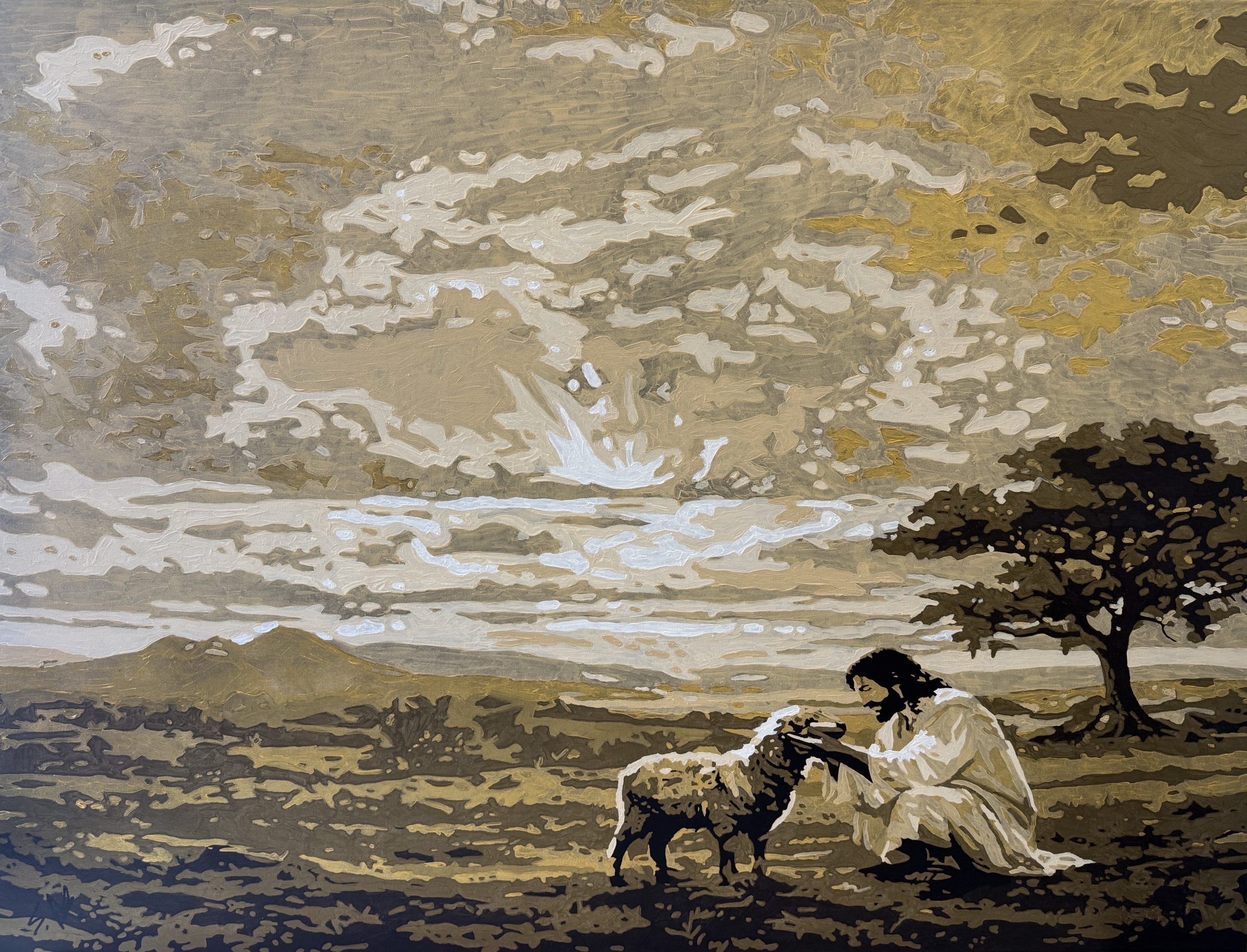
This painting feels most powerful when the vastness of the scene is contrasted with the tenderness of what Jesus is doing. Beneath an enormous, restless sky and across a landscape that seems to stretch forever, Jesus has stopped for one small lamb.
The lamb looks tiny against everything surrounding it—vulnerable and easily overlooked. But Jesus doesn’t call to it from a distance. He doesn’t stand above it. He kneels. He comes down into the dirt, reaches gently toward its face, and gives this one lamb His complete attention.
For that moment, nothing else seems to matter.
The painting captures something deeply personal about the heart of Christ. The lamb can represent the one who has wandered, the one who is hurting, the one who feels forgotten—or simply the one who needs the Shepherd. And Jesus’ posture tells the story: one is enough to search for. One is enough to kneel beside. One is enough to love.
Even the enormous sky helps tell that story. The world is still out there. There are countless places Christ could be and countless others He could be tending to, yet His attention is fixed on this single life. His hand beneath the lamb’s face isn’t forceful or corrective. It’s tender. There is no condemnation in the moment—only comfort.
And perhaps one of the most meaningful parts of the painting is something you don’t see:
The other ninety-nine.
They aren’t in the painting.
For this moment, there is only the Shepherd and the one.
But there is another important detail in where that meeting takes place.
Jesus and the lamb are positioned toward the right side of the painting, but not all the way at the edge. Jesus sought the lamb, but the lamb also had to turn and walk toward Him.
The lamb does not arrive looking beautiful.
It is worn. Dirty. Disheveled. Imperfect. Its wool carries the evidence of wherever it has been and whatever it has endured. Yet none of that matters to Jesus. He does not recoil from its condition. He does not demand that it first clean itself before approaching Him. What matters is that the lamb has turned toward its Shepherd.
And even then, the lamb seems unable to fully lift its head.
It bows as if in shame—as though aware of where it has been, what it has become, and how far it has wandered. Perhaps it expects judgment.
Instead, Jesus reaches beneath its face.
He gently lifts the lamb’s head toward His own, inviting it to meet His gaze. There is no anger in the gesture. No disgust. No condemnation. Only recognition, acceptance, and love.
It is the moment when shame encounters grace.
And that is why the painting is called “Peace.”
Not because the world surrounding them is peaceful. It isn’t. The sky remains restless. The landscape remains vast. The difficult path the lamb traveled still stretches behind it.
But peace was never found in the surroundings.
Peace is not the absence of a stormy sky.
Peace is not having a perfect path behind you.
Peace is not arriving before Jesus clean, composed, and without scars.
The lamb has not escaped the troubled world. The troubled world is still visible all around it.
It has simply found the one place where that world no longer has the final word.
The painting invites you to see yourself as that lamb. In a world filled with billions of people, Christ’s love isn’t divided into smaller and smaller pieces. When you are the one who needs the Shepherd, you are worth searching for. You are worth stopping for. You are worth kneeling beside. You are worth reaching for.
You only have to turn toward Him.
And when you do, you discover what the lamb has discovered:
Peace is found in the arms of Jesus.